

 Service Hotline : +86 15989996933

 2026-08-07
 8
8
 admin
admin
Amid tightening global plastic bans, rising ESG compliance requirements, and booming demand for green logistics, biodegradable machine stretch films are emerging as a transformative alternative to traditional LLDPE plastic packaging. As industries worldwide phase out single-use fossil-based plastics, compostable and bio-based stretch films designed for automatic wrapping equipment are rapidly penetrating smart warehouses, cross-border logistics, and food manufacturing sectors, reshaping the future of industrial pallet packaging.
For decades, the global industrial packaging market has relied heavily on conventional plastic stretch films, which require hundreds of years to decompose and generate massive industrial plastic waste. According to industry statistics, the global stretch film market exceeds USD 10.2 billion, with nearly all products derived from petroleum-based raw materials. To address environmental challenges, packaging manufacturers have made major breakthroughs in bio-based film research, successfully launching machine-grade biodegradable stretch films that meet international composting standards including EN 13432 and ASTM D6400, certified by TÜV Austria and other authoritative institutions.
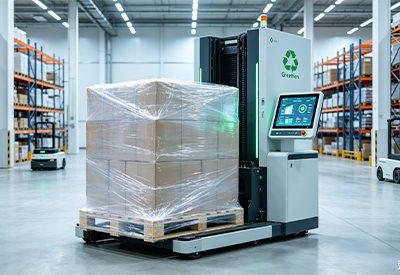
The new-generation biodegradable machine stretch films are mainly produced from sustainable raw materials such as PLA, PHA, plant cellulose and bamboo-based biopolymers. Different from manual degradable films with unstable performance, machine-specific biodegradable stretch films are professionally optimized for automatic wrapping equipment. They maintain high elongation of 300% to 350%, excellent tensile strength and puncture resistance, fully adapting to high-speed winding, tension adjustment and layered wrapping of intelligent pallet wrapping machines. The stable mechanical performance ensures tight pallet load fixation, effectively preventing cargo displacement, collision and moisture damage during long-distance transportation and stacked storage.
Cost and carbon reduction advantages have become key drivers for large-scale market adoption. Advanced biodegradable stretch film technologies have reduced carbon emissions by up to 59.5% compared with traditional plastic films, while cutting comprehensive packaging costs by 55%. Unlike early degradable packaging materials that were expensive and impractical, the upgraded bio-based films achieve balanced performance and cost, requiring no modification to existing automatic wrapping equipment. They support direct replacement use, enabling logistics and manufacturing enterprises to achieve green transformation without increasing operational burdens.
Product categories have been further enriched to meet diverse industrial scenarios. The current market covers two mainstream degradable solutions: industrial compostable stretch films and home compostable stretch films. Industrial compostable films can be completely decomposed within a standardized industrial composting cycle, while innovative home compostable products realize full biodegradation in natural household environments without professional composting equipment, solving the end-of-life disposal dilemma of industrial packaging waste. In addition, bamboo-based biodegradable films, made from pure plant cellulose extraction technology, have achieved full green production and zero fossil material addition, becoming a new favorite in high-end green supply chains.
Market research data shows that the global biodegradable wrap systems market will grow at a CAGR of 9.1% from 2026 to 2036, reaching USD 0.7 billion in 2026 and soaring to USD 1.8 billion by 2036. Driven by EU plastic restriction policies, global carbon neutrality goals and corporate green procurement standards, food and beverage, cross-border e-commerce, chemical manufacturing and retail industries are accelerating the replacement of traditional plastic films with degradable machine stretch films.



huicheng868@sina.com
+86 15989996933
+86 13702929126
No. 4, Waihaitang Development Zone, Xiqiao, Shangjinou,Xiqiao Town, Nanhai District, Foshan City
huicheng868@sina.com
+86 15989996933
+86 13702929126
No. 4, Waihaitang Development Zone, Xiqiao, Shangjinou,Xiqiao Town, Nanhai District, Foshan City